


Difficulty breathing and wheeze
-
Wheeze is extremely common in young children. It is most often triggered by a viral infection. Most preschool children with wheeze do not have asthma.
-
Children under 2 years of age with breathing difficulty may have bronchiolitis (Please insert hyperlink to local bronch). This is an extremely common condition. It usually starts with a runny nose and cough, but their breathing may get worse over the next 2 to 3 days. For those under 1 year of age, inhalers generally do not help.
-
If your child has croup (hoarse voice, barking cough, noisy breathing), they are likely to need assessment by a medical practitioner.
-
If you already have a salbutamol (blue) inhaler, please follow your treatment plan.
-
If your child has been diagnosed with asthma, please see our resources for how to manage asthma attacks.
When should you worry?
If your child has any of the following:
-
Breathing very fast, too breathless to talk, eat or drink
-
Working hard to breathe, drawing in of the muscles below the ribs, or noisy breathing (grunting)
-
Breathing that stops or pauses
-
A harsh noise as they breathe in (stridor) present all of the time (even when they are not upset)
-
Is pale, blue, mottled or feels unusually cold to touch
-
Difficult to wake up, very sleepy or confused
-
Weak, high-pitched cry or can’t be settled
-
Has a fit (seizure)
-
Has a rash that does not go away with pressure (the ‘Glass Test’)
-
Is under 3 months old with temperature more than 38°C or under 36°C (unless fever in the 48 hours following vaccinations and no other red features)
You need urgent help
Go to the nearest Hospital Emergency (A&E) Department or phone 999
If your child has a salbutamol (blue) inhaler please follow your treatment plan
If your child has any of the following:
-
Breathing a bit faster than normal or working a bit harder to breathe
-
A harsh noise as they breathe in (stridor) only when upset
-
Dry skin, lips or tongue
-
Not had a wee or wet nappy in last 8 hours
-
Poor feeding in babies (less than half of their usual amount)
-
Irritable (Unable to settle them with toys, TV, food or hugs even after their fever has come down)
-
Is 3 to 6 months old with temperature 39°C or above (unless fever in the 48 hours following vaccinations and no other red or amber features)
-
Temperature of 38°C or above for more than 5 days or shivering with fever (rigors)
-
Temperature less than 36°C in those over 3 months
-
Getting worse and I am still worried
You need to contact a doctor or nurse today
Please ring your GP surgery or call NHS 111 - dial 111
If your child has a salbutamol (blue) inhaler please follow your treatment plan
If symptoms persist for 4 hours or more and you have not been able to speak to either a member of staff from your GP practice or to NHS 111 staff, recheck that your child has not developed any red features
If none of the above features are present:
-
Watch them closely for any change and look out for any red or amber symptoms
-
If your child has any other symptoms associated with their fever, you may want to look at the information on sore throat, cough, earache, diarrhoea and vomiting or tummy ache or our other pathways.
Self care
Continue providing your child’s care at home. If you are still concerned about your child, call NHS 111 – dial 111
This content has been developed by healthcare professionals from across the UK in collaboration with the RCPCH.
What should you do?
-
Continue to place your baby on their back to sleep.
-
Keep your baby’s sleep surface flat. Do not incline, tilt or prop the mattress, cot or baby unless advised by a health care professional
-
Avoid co-sleeping with your baby if they are unwell with bronchiolitis or a respiratory tract infection. For more information, see our safe sleeping page.
-
Avoid exposure to tobacco smoke which makes their breathing worse. Remember that smoke stays on your clothes even if you smoke outside.
-
If you would like help to give up smoking you can get information and advice from your local GP surgery or by calling the National Stop Smoking Helpline Tel: 0300 123 1044.
How long will your child’s symptoms last?
- Although your child’s cough is likely to last for 2 to 3 weeks, they should not be breathless or wheezy for more than 3 or 4 days
- The charts below show how long croup or bronchiolitis last in children. The faces represent 10 children who have croup or bronchiolitis. Green faces are those children who have recovered within that time period
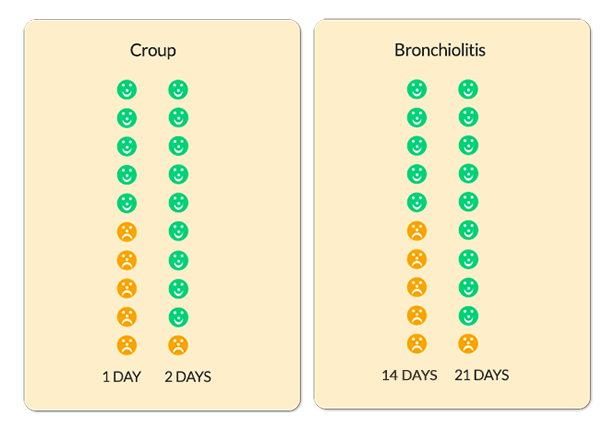
The diagrams above are taken from www.whenshouldiworry.com
Where should you seek help?
- If it is non-urgent, speak to your local pharmacist or health visitor.
- If your child has any of the above features, urgently see your GP. For an urgent out-of-hours GP appointment, call NHS 111.
- You should only call 999 or go your nearest A&E department in critical or life threatening situations.
Health visitors are nurses or midwives who are passionate about promoting healthy lifestyles and preventing illness through the delivery of the Healthy Child Programme. They work with you through your pregnancy up until your child is ready to start school.
Health Visitors can also make referrals for you to other health professionals for example hearing or vision concerns or to the Community Paediatricians or to the child and adolescent mental health services.
Contact them by phoning your Health Visitor Team or local Children’s Centre.
Sound advice
Health visitors also provide advice, support and guidance in caring for your child, including:
- Breastfeeding, weaning and healthy eating
- Exercise, hygiene and safety
- Your child’s growth and development
- Emotional health and wellbeing, including postnatal depression
- Safety in the home
- Stopping smoking
- Contraception and sexual health
- Sleep and behaviour management (including temper tantrums!)
- Toilet training
- Minor illnesses
For more information watch the video: What does a health visitor do?
School nurses care for children and young people, aged 5-19, and their families, to ensure their health needs are supported within their school and community. They work closely with education staff and other agencies to support parents, carers and the children and young people, with physical and/or emotional health needs.
Primary and secondary schools have an allocated school nurse – telephone your child’s school to ask for the contact details of your named school nurse.
There is also a specialist nurse who works with families who choose to educate their children at home.
Sound Advice
Before your child starts school your health visitor will meet with the school nursing team to transfer their care to the school nursing service. The school nursing team consists of a school nursing lead, specialist public health practitioners and school health staff nurses.
They all have a role in preventing disease and promoting health and wellbeing, by:-
- encouraging healthier lifestyles
- offering immunisations
- giving information, advice and support to children, young people and their families
- supporting children with complex health needs
Each member of the team has links with many other professionals who also work with children including community paediatricians, child and adolescent mental health teams, health visitors and speech and language therapists. The school health nursing service also forms part of the multi-agency services for children, young people and families where there are child protection or safeguarding issues.
If you’re not sure which NHS service you need, call 111. An adviser will ask you questions to assess your symptoms and then give you the advice you need, or direct you straightaway to the best service for you in your area.
Sound advice
Use NHS 111 if you are unsure what to do next, have any questions about a condition or treatment or require information about local health services.
For information on common childhood illnesses go to What is wrong with my child?
A&E departments provide vital care for life-threatening emergencies, such as loss of consciousness, suspected heart attacks, breathing difficulties, or severe bleeding that cannot be stopped. If you’re not sure it’s an emergency, call 111 for advice.